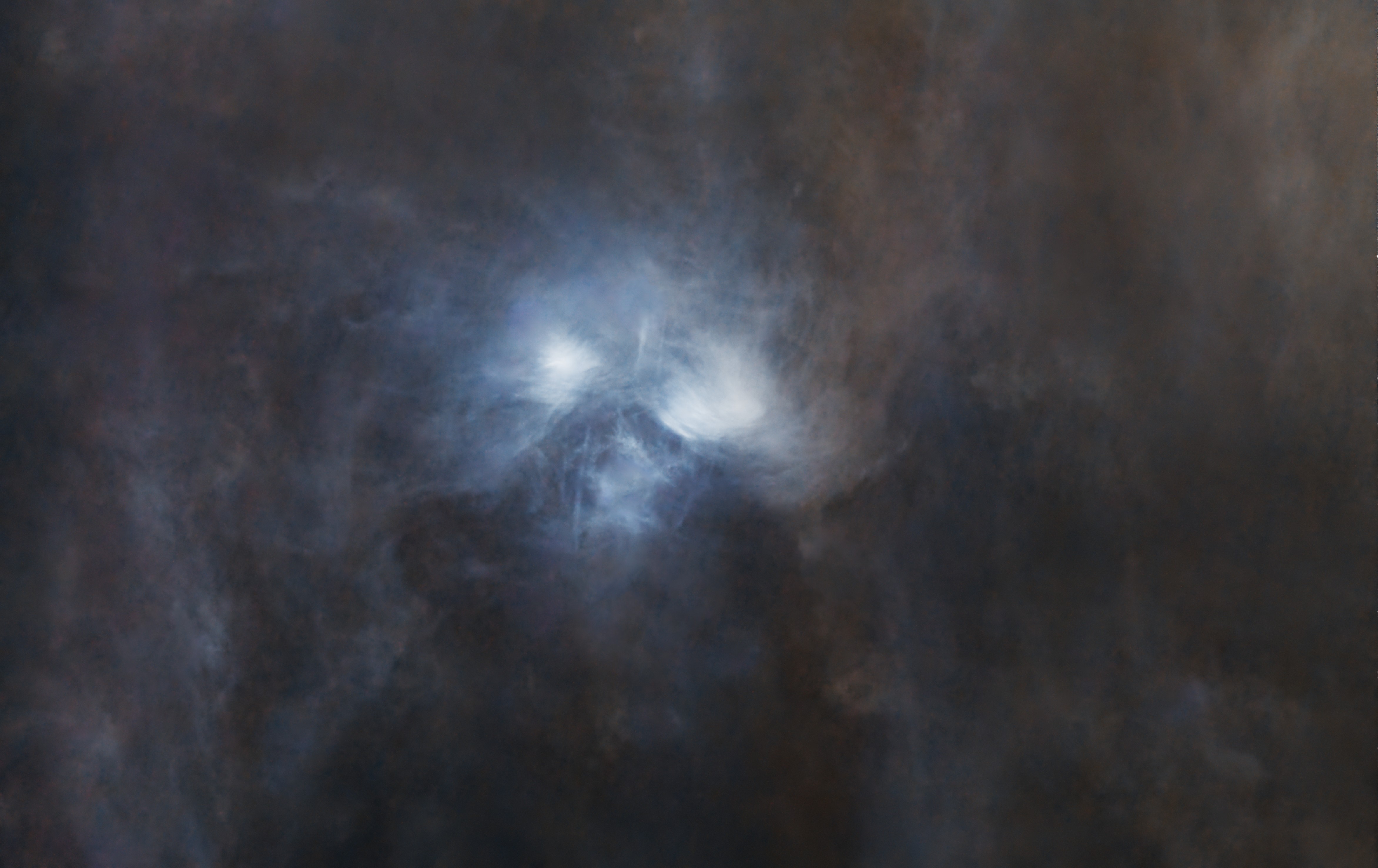
What started with the awe of the night sky, taught me the same discipline needed to learn to process signals.
Patience, Planning, and Focus are three of the key features I've learned over the last 5 years doing Astrophotography.
$ gh repo clone kimbrow-slice/gallery/astrophotography
$ cd Astrophotography
$ mkdir astro
Beneath the Photons - Raw Packet turned Digital
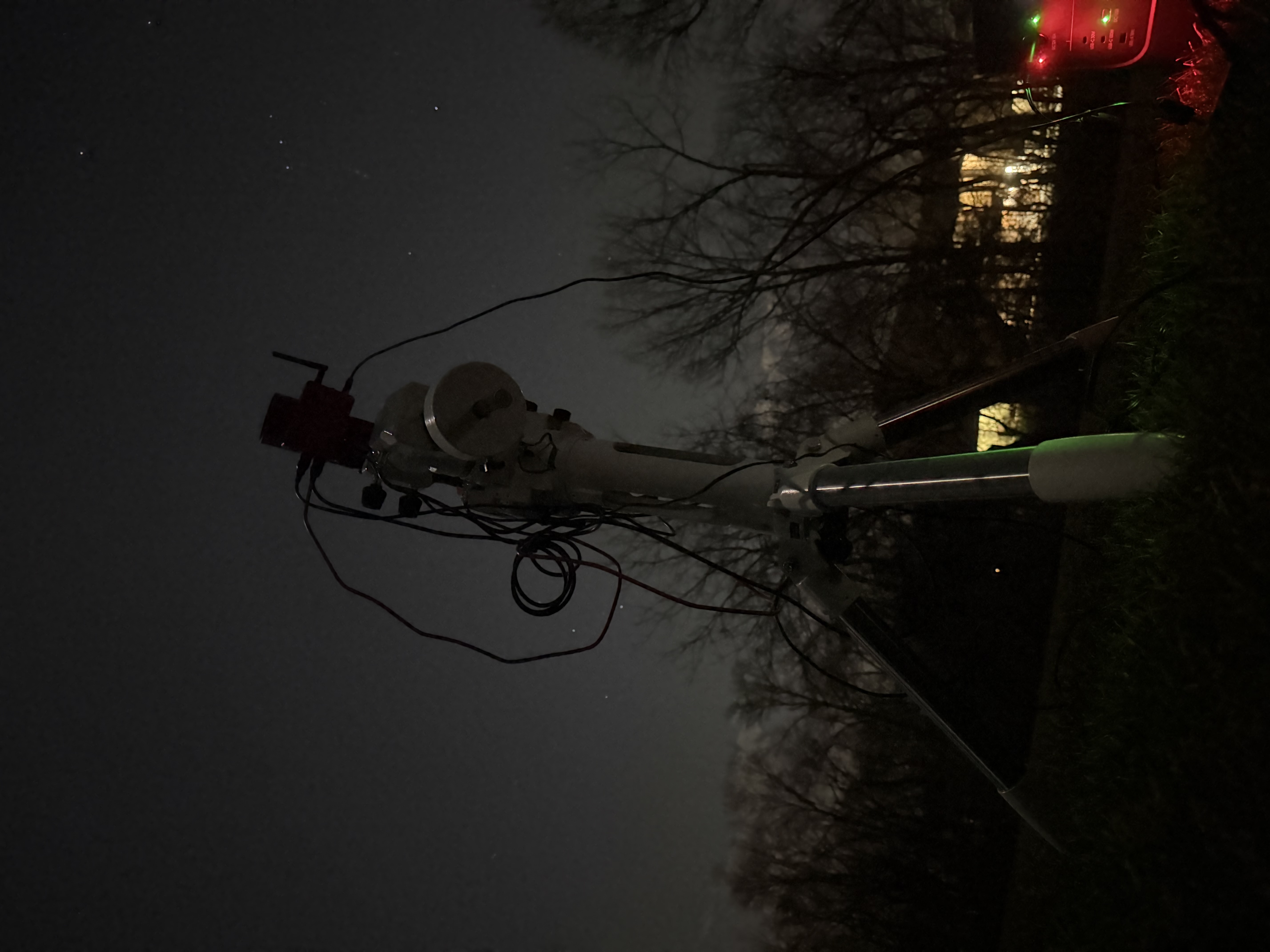
Astrophotography begins with a deceptively simple idea: point a camera at the night sky and capture light that has traveled across the universe. In practice, it is a careful orchestration of hardware, timing, and environmental awareness. Telescopes act as the optical front-end, guiding systems maintain precision tracking, and cameras act as the sensor that converts incoming photons into digital signal.
Unlike daytime photography, where light is abundant, astrophotography operates at the edge of visibility. Targets such as nebulae or distant galaxies emit extremely faint signals. To capture them, exposures often run for minutes at a time while the telescope mount compensates for the Earth’s rotation. Every frame becomes a small packet of information — a raw sample of the sky that will later contribute to a larger signal reconstruction.
This is where patience, planning, and focus begin to matter. Sessions are often planned days in advance around moon phase, sky transparency, and atmospheric stability. Equipment must be aligned precisely, guiding must remain stable, and power systems must run reliably through long capture sessions. A single imaging night might produce hundreds of frames, each representing a fragment of the target signal.
The result of this process is what astrophotographers call light frames: raw photon measurements translated into digital data. At this stage the image is noisy, imperfect, and often visually unimpressive. But just like raw network traffic before parsing, these packets contain the signal we care about — the structure hidden inside the noise.
return astro.signal(raw)Narrowing the bands - Filtering through spectrometry.
Once raw light frames are captured, the next challenge becomes signal isolation. In astrophotography this is often done using narrowband filters, which allow the camera to capture only specific wavelengths of light emitted by astronomical objects. Instead of recording the entire visible spectrum at once, the sensor is restricted to precise spectral windows.
Common filters target hydrogen-alpha (Ha) and doubly ionized oxygen (OIII) emissions. These wavelengths correspond to physical processes occurring within nebulae and star-forming regions.
By isolating them individually, astrophotographers effectively separate overlapping signals that would otherwise be blended together in a standard color image.
From a signal-processing perspective, this step resembles band-pass filtering. The goal is not simply to capture more data, but to capture cleaner data. By rejecting unwanted wavelengths — including light pollution and atmospheric interference — the resulting frames emphasize the structures we are trying to measure.
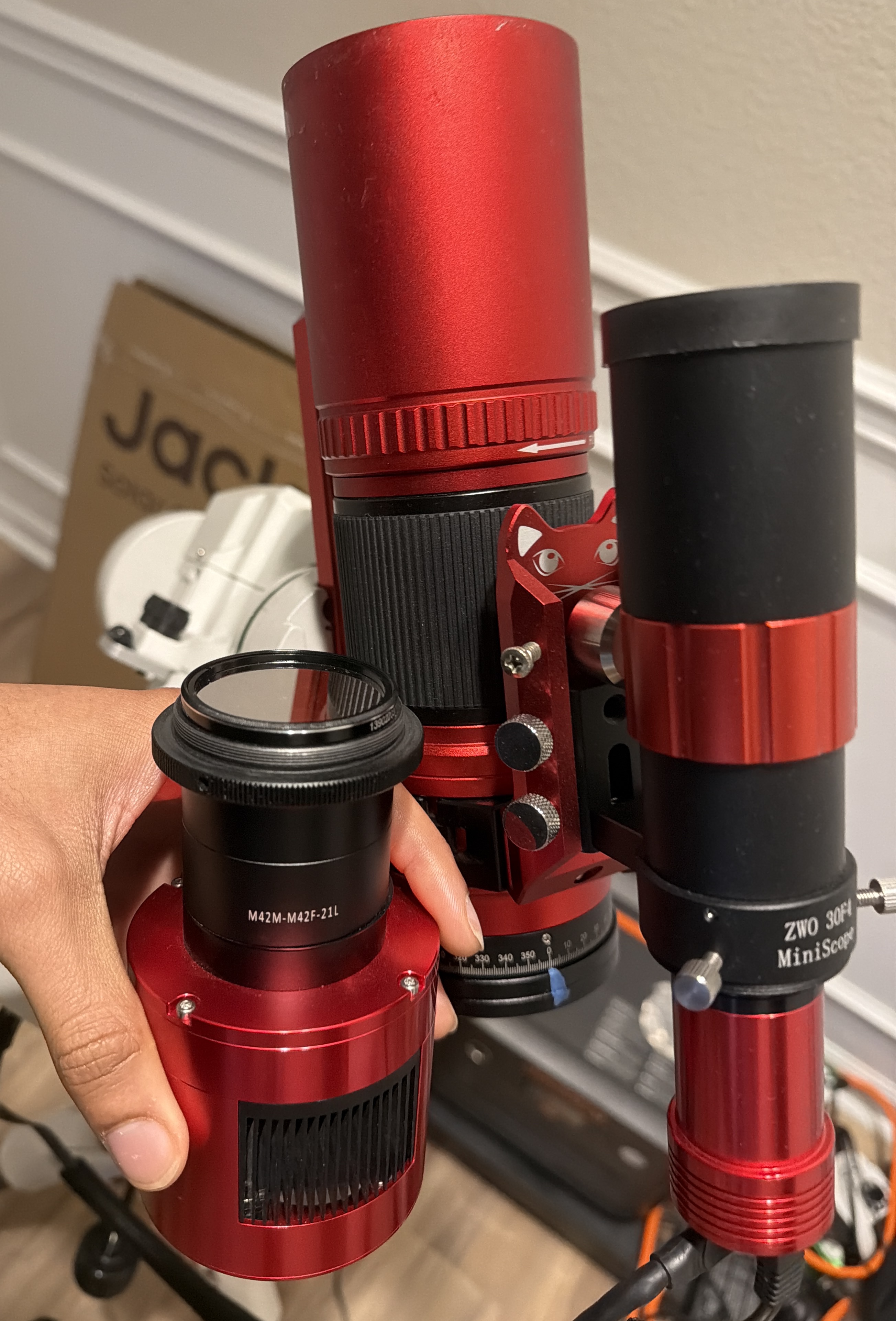
- Improved signal isolation for emission nebulae
- Reduced impact from urban light pollution
- Higher contrast between target structures and background sky
- Independent capture of Ha and OIII spectral information
- Greater control during post-processing and color mapping
commit astro.filter --message="cleaned the raw input data for better interpretation"Base Signal to Noise Ratio - Anomaly Reduction
Even with spectral filtering, raw astronomical images still contain significant noise. Sensors introduce thermal noise, optical systems produce uneven illumination, and dust within the imaging train can leave subtle artifacts across the frame. These distortions must be removed before meaningful interpretation can begin.
Astrophotographers address this using a set of calibration frames. Dark frames measure thermal noise produced by the sensor itself. Bias frames capture the readout pattern of the camera electronics. Flat frames correct for uneven illumination and optical dust shadows. Dark flats combine aspects of both dark and flat calibration to ensure consistency.
These calibration frames function as reference measurements. By subtracting or normalizing them against the light frames, the system removes repeatable distortions that would otherwise mask the real astronomical signal. The process resembles anomaly reduction in signal processing, where known noise sources are characterized and mathematically removed.
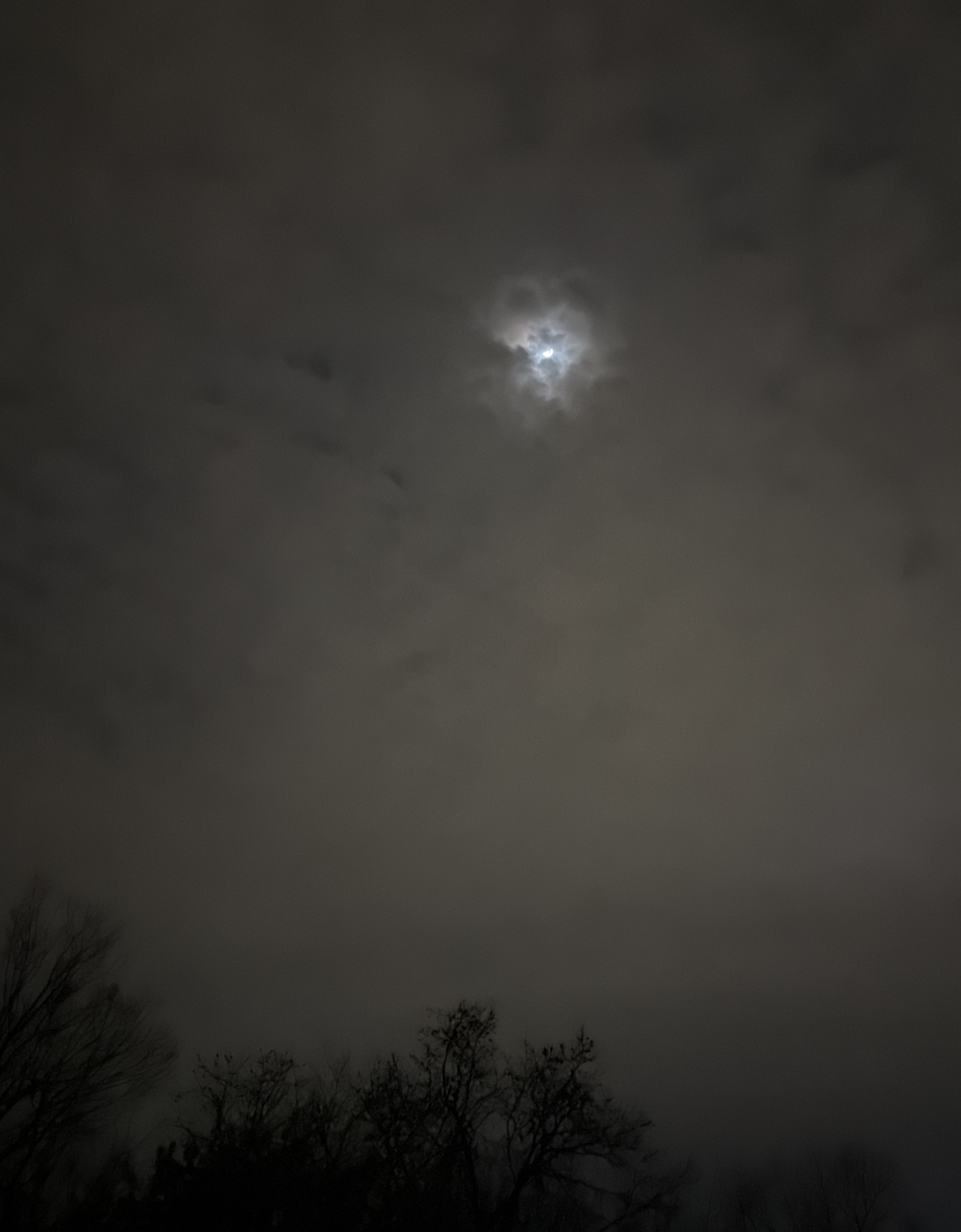
Another critical element of astrophotography planning happens long before the telescope is even powered on: weather modeling. Atmospheric conditions directly influence signal quality. Cloud layers, jet stream turbulence, and humidity levels can all degrade captured data.
For many astrophotographers, forecasting tools such as the College of DuPage Next Generation Weather Lab provide essential visibility into upcoming observing conditions. By analyzing these models ahead of time, imaging sessions can be scheduled around clear windows of atmospheric stability, reducing wasted travel and increasing the probability of successful signal capture.
commit astro.snr --message="captured offset frames to reduce noise"Stacking the Integration - Interpreting the Signal through the Noise
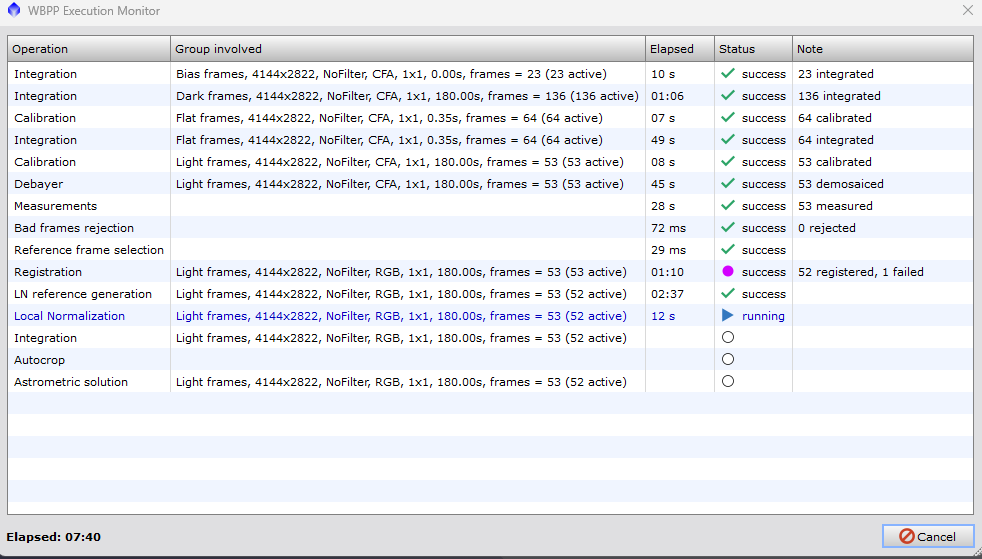
After calibration and filtering, hundreds of individual exposures remain. Each frame contains a faint version of the same astronomical signal, buried beneath varying levels of noise. The next step is integration: combining these frames into a single representation that reinforces the signal while suppressing random noise.
Stacking algorithms align each image using detected star positions, correcting for small shifts or rotations between exposures. Once aligned, the frames are averaged or statistically combined. Random noise tends to cancel out across many exposures, while consistent signal features reinforce one another.
The result is a dramatically improved signal-to-noise ratio. Structures that were previously invisible begin to emerge such as filaments of gas, dust lanes, and emission regions. What once appeared as noise becomes interpretable structure. This transition from raw data to coherent image mirrors the transformation seen in many signal-processing pipelines.
merge signal.filter.snr --strategy=interpretation Process Components & Methodology
[diff^2.0]://SignalAlignment/GeneralizedHyperbolicStretches/FFT
Astrophotography processing can be viewed as a layered system where each component performs a specific responsibility within the signal pipeline. From acquisition to interpretation, the workflow gradually transforms raw photon measurements into a structured representation of astronomical phenomena.
Alignment algorithms ensure that frames captured across hours of observation remain spatially consistent. Fourier transforms and frequency-domain operations allow subtle signal patterns to be analyzed and enhanced. Stretching functions such as Generalized Hyperbolic Stretch expand faint signal ranges so that human perception can detect structures previously hidden in the noise floor.
Together these tools form a processing stack similar to many computational pipelines. Each stage performs a constrained transformation while preserving the underlying signal integrity. When combined correctly, the pipeline reveals a final image that represents the accumulated interpretation of all captured data.
Methodology
Processing and interpretation
- Signal alignment (star registration / subframe alignment)
- Frequency-domain tools (FFT for pattern / artifact inspection)
- Dynamic range shaping (Generalized Hyperbolic Stretch)
Core Components
Light Frames — Raw Signal
- Function: capture target photons as the primary measurement set
- Strengths: contains the real structure (nebulae, dust lanes, star fields)
- Risks: tracking errors, gradients, saturation, variable seeing
- Triggers: exposure length, gain/ISO, guiding stability, sky conditions
- Output: calibrated inputs for integration and downstream processing
Offset Frames — Noise & System Characterization
- Function: model repeatable sensor + optical artifacts for removal
- Strengths: reduces fixed-pattern noise; corrects vignetting and dust motes
- Risks: mismatch in temperature, exposure, gain, or optical train changes
- Triggers: camera temperature, filter swaps, focus changes, sensor settings
- Output: dark/bias/flat corrections used to normalize light frames
Integration Layer — Calibration && Registration && Rejection && Integration
- Calibration: apply dark/bias/flat corrections to reduce systematic noise
- Registration: align frames using star matching to preserve geometry
- Rejection: remove outliers (satellites, planes, hot pixels) during stacking
- Integration: combine frames to boost SNR and reveal faint structure
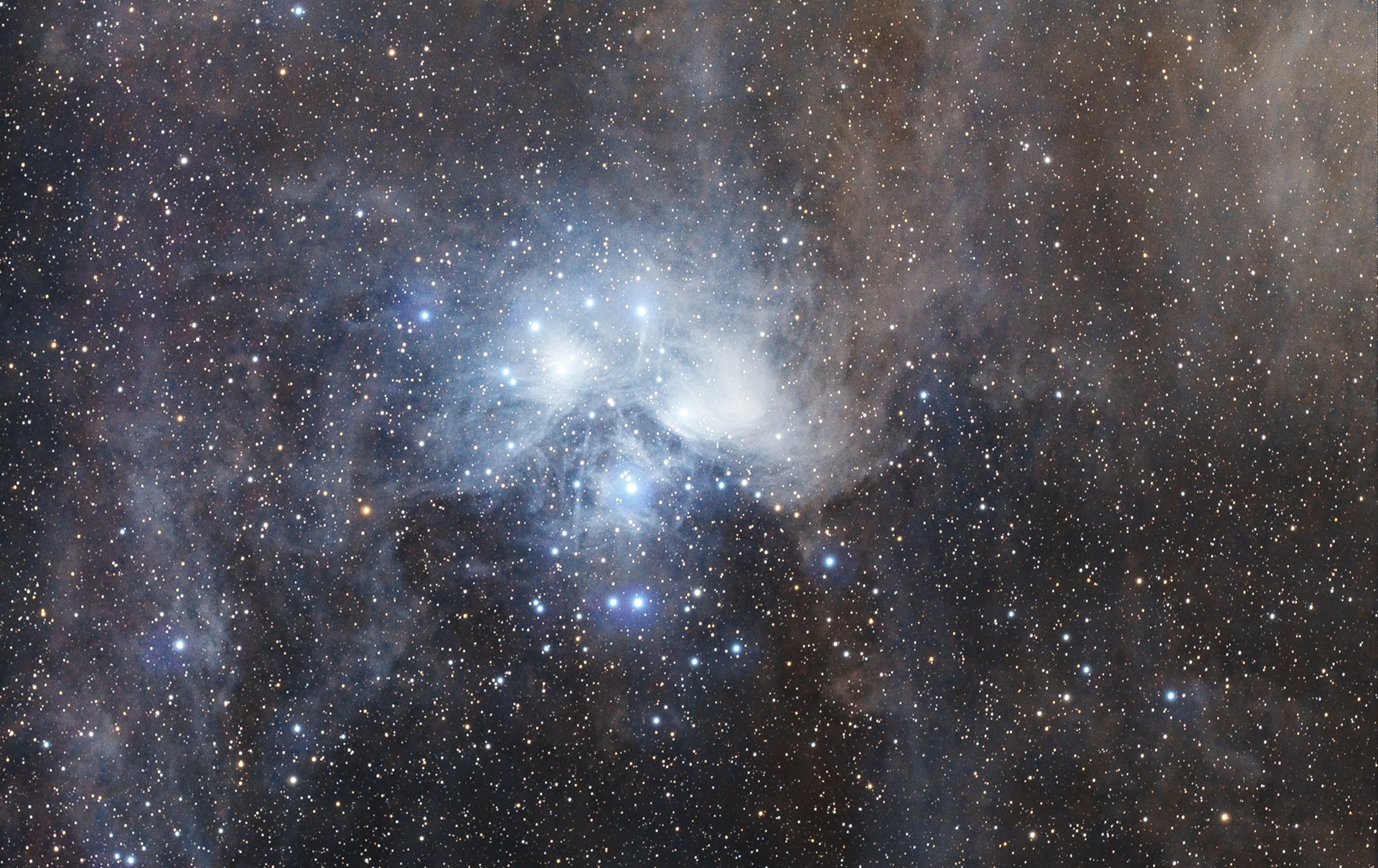
- Output: a single high-SNR master image ready for interpretation
Conclusion
Astrophotography began for me as a hobby driven by curiosity about the night sky. Over time, the discipline required to capture and process faint signals revealed something deeper: the same principles that guide astrophotography also appear throughout signal processing and computational systems.
Capturing photons from distant objects demands patience, structured workflows, and careful interpretation of noisy data. Whether analyzing astronomical images or debugging complex systems, the process follows a familiar pattern: isolate the signal, remove the noise, and integrate observations until the structure becomes clear.
What started as nights spent under dark skies eventually shaped the way I approach technical problems. Astrophotography didn’t just teach me how to capture the universe — it taught me how to interpret signals hidden within it.
Here is where you can view more of my astrophotography work Astro Gallery
Acknowledgments
As many experiences in life, this journey wasn't done alone. Thank you to those who helped me learn the discipline, Patience, and provided support ranging from photons to weather models.